
Associação Portuguesa de Investigação em Cancro
Duplo mecanismo de evasão imunitária molda tumores colorretais MMRd
Duplo mecanismo de evasão imunitária molda tumores colorretais MMRd
Uma equipa de investigadores do Instituto de Investigação e Inovação em Saúde (i3S) da Universidade do Porto identificou vulnerabilidades persistentes em tumores colorretais que poderão ser exploradas no desenvolvimento de vacinas terapêuticas personalizadas contra o cancro. O estudo, publicado na revista Gut, demonstra que, apesar de estes tumores conseguirem escapar ao controlo do sistema imunitário, mantêm neoantigénios capazes de desencadear uma resposta imunitária eficaz. Segundo José Carlos Machado, o tumor cria um ambiente imunossupressor que impede o sistema imunitário de eliminar as células tumorais, mas não elimina o seu potencial de reconhecimento. A identificação dos neoantigénios imunogénicos fornece uma base sólida para o desenvolvimento de vacinas desenhadas à medida de cada doente, de acordo com as características genéticas do seu tumor. Os resultados contribuem para uma melhor compreensão da evolução do cancro sob pressão imunológica e reforçam o potencial das imunoterapias personalizadas como uma nova abordagem no tratamento do cancro colorretal.
Helena Xavier-Ferreira(1,2), Ana Vilarinho(1,3), Bruno Cavadas(1), José L. Costa(1,3), Fátima Carneiro(1,3), Bauke Ylstra(4), Noel de Miranda(5), Carlos Resende(1), José C. Machado(1,3)
1- i3S Instituto de Investigação e Inovação em Saúde, University of Porto; Porto, Portugal
2- ICBAS School of Medicine and Biomedical Sciences, University of Porto, Porto, Portugal
3- Faculty of Medicine, University of Porto, Porto, Portugal
4- Department of Pathology, Cancer Center Amsterdam, Amsterdam UMC, Vrije Universiteit Amsterdam, Amsterdam, The Netherlands
5- Department of Pathology, Leiden University Medical Center, Leiden, the Netherlands
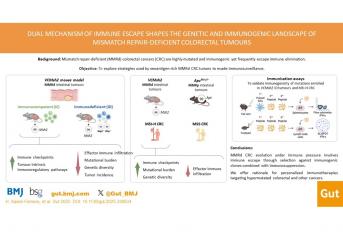
Background: Mismatch repair-deficient (MMRd) colorectal cancers (CRCs) are highly mutated and immunogenic yet frequently escape immune elimination. Objective: To define how host immunity shapes the genomic architecture and tumour microenvironment of MMRd CRC. Design: We used a genetically engineered mouse model of MMRd CRC to compare tumour development in immunocompetent and immunodeficient hosts. Tumours were characterised for microenvironment composition, immunoregulatory pathways, mutational burden and genetic diversity. Immunogenicity of selected mutations was tested and findings were validated in human samples. Results: In immunocompetent hosts, immune pressure reduces tumour incidence through selective elimination of early neoplastic clones bearing immunogenic mutations, consistent with antigen-specific immunoediting. Tumours exhibit a suppressive microenvironment with reduced cytotoxic lymphocytes and elevated immune checkpoint proteins. Tumours from immunodeficient mice showed higher mutational burden, greater genetic diversity and enrichment of mutations absent in immunocompetent animals, several of which encode neoantigens that elicit CD8+ T cell responses. Analyses of human CRCs with high microsatellite instability (MSI-H) confirmed retention of the same immunogenic mutations, elevated mutational burden, reduced effector immune infiltration and expression of immune checkpoint proteins. These results support a dual mechanism of immune escape, immunoediting and local immunosuppression, allowing MMRd CRC tumours to persist despite immune recognition. Conclusion: We show that immunosurveillance plays a dual role in constraining tumour development and sculpting the genetic and immunological landscapes of MMRd tumours. This evasion strategy explains the paradox of immune-rich yet progressive MMRd tumours and highlights vulnerabilities that could be exploited by neoantigen-based or immune reactivation therapies.
Gut
https://gut.bmj.com/content/early/2026/06/16/gutjnl-2025-336834